Racism is the Virus

I decided to do my video remix on the topic of misinformation and disinformation in the age of COVID-19. Specifically, I focused on the violence and discrimination against Asians and Asian-Americans in the United States that spread as a result of xenophobic thought and language perpetuated even by leaders of our country.

The video starts with a screen recording of someone searching up “the chinese virus” on Google. It then transitions to a clip from a video called “Asian Americans face discrimination in the wake of the coronavirus” which features a newscaster explaining that the hateful attitude toward Asians is being exacerbated by our nation’s leaders. I then cut to clips of White House staff and President Trump using deliberately misleading terms including “the Chinese Virus” and “Kung Flu.” I wanted to contrast the way they lightly throw around such terms with the next clip which argues that using such terms can have very dangerous implications. The man speaking, John Yang (President of Asian Americans Advancing Justice), says that the language suggests that Chinese people as a whole are to blame for COVID-19. I wanted to emphasize this idea of blame, so the next clip is that of Trump responding to a reporter’s question about who he thinks is to blame. It then cuts to a clip in which he says he believes this is “not racist at all.” The next clip goes back to the argument that “words matter,” especially because they now carry a threat of physical violence against the Asian-American community.

I then included a montage of recent instances of violence from various news reports: “There’s something spreading faster than the coronavirus…racism,” “Asians facing discrimination, violence amid coronavirus outbreak,” “Coronavirus outbreak sparks xenophobia and racist attacks,” and “Student Group Aims to Tackle Racism Amid Coronavirus Panic.” In one of the clips, a man is shown saying, “If you’re from China, I need to know.” I played on this idea of people thinking they “know” anything about a person or their health just from knowing their race with the following video clip which argues that, “They don’t know anything about you, but they just think you are the carrier of the virus.” 

After a clip and voice-over that show the attacks against Asians wearing masks, the same voice as before questions why anyone would attack someone simply for wearing a mask. The woman in the next video answers the question; “this is the result of misinformation being spread.” The previous woman then says that this is “not the excuse to treat people differently,” which is precisely one of the messages of my video.

The video then transitions to the story of Asian-American doctors who are at the frontlines of the COVID-19 medical crisis. It opens with a stunning statistic that states that “17 percent of America’s doctors are of Asian descent.” I then included a montage of clips showing Asian and Asian-American doctors on the job and also facing discriminatory remarks despite their contributions: “New York City doctor: ‘The things that I see in the ER are scary,’” “Asian American Doctors Unite Against COVID-19 Racism: Hate is a Virus,” “Coronavirus: Hero doctor who tried to warn the world about bug is killed by the disease,” and “COVID-19: Asian-American Doctor On Being ‘Both Celebrated And Villainized At The Same Time.’” The voice-over expresses feeling strange about the dichotomy of being “both celebrated and villainized at the same time.”

The final voice-over plays over a series of doctors holding up messages that show their identity as humans just like everyone else and also encourage us to be kind during this time. The woman’s voice explains that she is proud of being Chinese, but this does not make her a carrier of coronavirus. She suggests that COVID-19 is not specific to a race, but it is instead a world health problem. 

The final cuts of the video return to the Google search from the beginning. It shows that “the chinese virus” does not yield any results, and people should opt for terms that are medically accurate and not racially charged like “COVID-19” and “coronavirus.” The last clip is my call to action, which — following the format of Google search suggestions — reminds people to “spread facts, not fear” and “wash [their] hands of xenophobia” and that “racism is the virus.” 

The music used throughout the video was chosen for its dramatic and heavy feel. 
Passwords, Personal Information, and “Privacy”

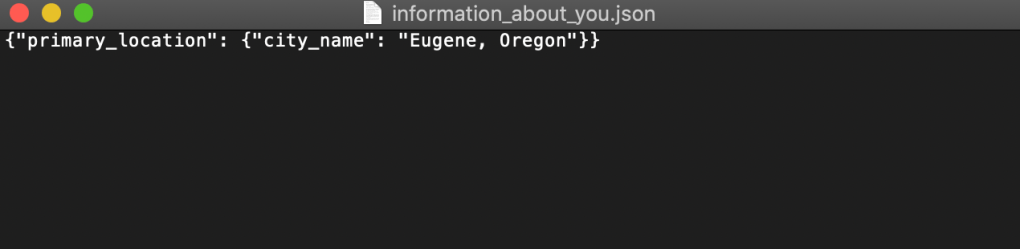
For this blog post, I downloaded all the information that Instagram has on me. I was pleasantly surprised to find that the only personal personal information they have on me is my hometown (Eugene, OR) and my contacts, at least on the surface. I was not-as-pleasantly surprised to find that they keep track of every time I have ever changed the text in my bio. I thought I was clever in like — 2015, apparently (“Pointe shoes are the real high heels”). It was interesting to learn that Instagram keeps track of all the content I have “seen” as well as anything I have ever written or received, whether that be comments or “private” direct messages. 

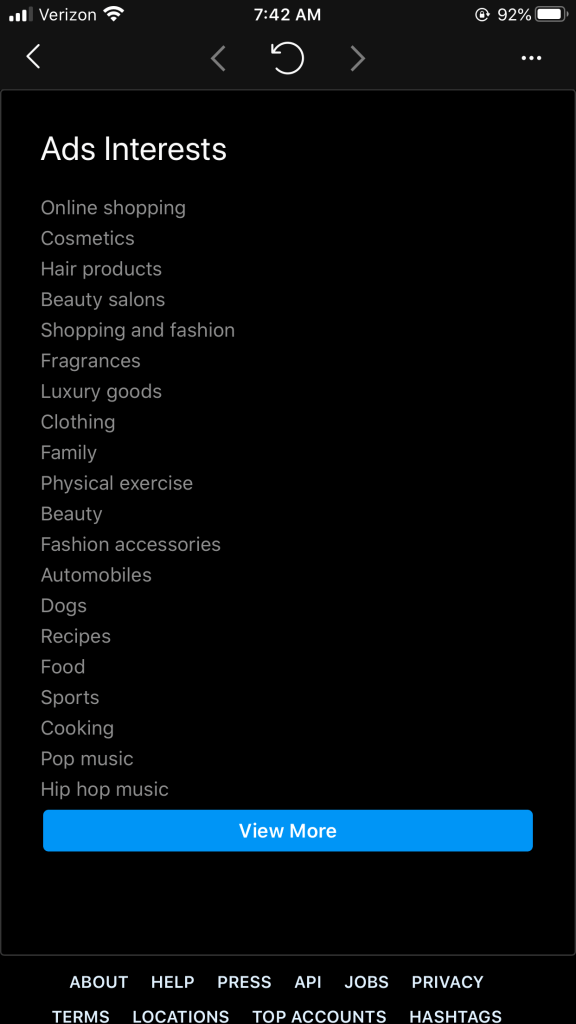
I found that one of the sources of information Instagram has on me is called “Ads Interests.” Listed under this section is everything from “shopping and fashion” to “dogs” to “rice.” One of the economic incentives of social media including Instagram, which is owned by Facebook, is to make money through advertisements. On a platform in which we are constantly showing our approval of things through likes and comments, it is incredibly easy for Instagram to know what things we like and are likely to spend our money on. As a business model, it is super intelligent; since we are more likely to interact with ads that align with our hobbies, passions, and likes, using information we willingly provide to the platform to discern those things is a good way to increase ad money. Personally, I do not really mind that my ads are tailored to me. While I may not buy the exact product advertised, the ads I get sometimes give me inspiration to buy similar products.

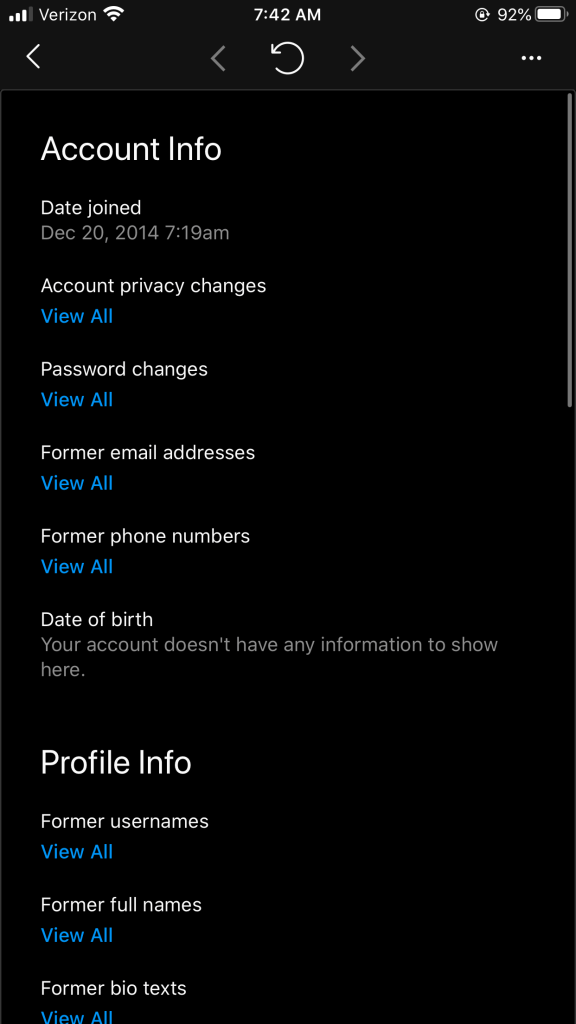
One thing I found unnerving is that Instagram also keeps track of every time I change my password. Since I have never changed my password for this account, it does not have anything recorded as of now. When logging into the app, I have never thought about the fact that the password I input is saved somewhere, while that might seem obvious. The implications of this is that Instagram has access to a password that I use for almost everything (This is dangerous, and I should change it, I know). If the saved information were ever sold or otherwise used for malicious intents, a single platform could potentially be able to access everything I have ever put on the internet.

In addition, it is concerning that I have essentially given Instagram permission to read through all of my messages and conversations. In the “information about you” section, they claimed to only know the city I live in, but from my DMs and comments, they can definitely glean further information about where I go to school, who my friends and family are, etc. While none of it is necessarily information that my life would end if it was broadcast to the world, it still feels like an invasion of privacy. That being said, in the time being, during which we are hard-pressed to stop social media platforms from saving (and or distributing) our information, I believe we should operate under the assumption that nothing we say or do on the Internet is private.

Celebrity Culture and Social Media in the Age of COVID-19

One piece of news that stood out to me is an article titled “Celebrity Culture is Burning” by Amanda Hess of The New York Times. The article offers an intriguing discussion about how celebrity culture is crumbling in the midst of the COVID-19 pandemic. Celebrities get a lot of flack from non-celebrities jealous of the excessive wealth and status that celebrities enjoy. However, this is usually toned down to bearable heights because even we “normal people” recognize that most celebrities got to where they are through talent and hard work. Usually, we even praise them for it. “But,” Hess writes. “The dream of class mobility dissipates when society locks down, the economy stalls, the death count mounts and everyone’s future is frozen inside their own crowded apartment or palatial mansion.” Since the beginning of the pandemic, celebrities have been heavily criticized for complaining about having to stay inside their giant mansions with endless availability of resources and entertainment as well as for not using their excessive wealth to contribute toward preventing the spread of COVID-19.

Gal Gadot et al. received a lot of backlash for a video posted on Instagram that featured herself and over twenty celebrity friends singing a cover of John Lennon’s “Imagine.”

Gadot captioned the video, “We are in this together, we will get through it together. Let’s imagine together. Sing with us ❤️ All love to you, from me and my dear friends.” I believe the video was well-intentioned — meant to lift our spirits in the midst of the COVID-19 pandemic — but it was perhaps made in poor taste. Jon Caramanica of the Times writes in an article titled “This ‘Imagine’ Cover is No Heaven” that “The presumption that an empty and profoundly awkward gesture from a passel of celebrities has any meaning whatsoever borders on delusion.” This comes from a culture in which celebrities are “accustomed to receiving accolades for ‘using their platforms’ to ‘raise awareness’” for a cause rather than contributing anything of monetary or practical value as if “the very appearance of a celebrity is a salve, as if a pandemic could be overcome by star power alone” (Hess).

Some celebrities, namely Vanessa Hudgens, have come under fire for minimizing the dangers of the COVID-19. One piece of media that stood out to me is an Instagram Live in which Hudgens said about the virus: “Sounds like a bunch of bullshit, but, like, it’s a virus — I get it. I respect it, but, at the same time, like, even if everybody gets it, like, yeah, people are gonna die. Which is terrible, but, like, inevitable?” This points to the ignorance and lack of empathy that is present on social media as a whole. Since COVID-19 is not known to seriously affect young, otherwise healthy individuals, many people who fit that description are not taking the virus seriously. While they may be safe, elderly and immunocompromised people are at serious risk of infection, this is exacerbated when young people ignore the regulation to stay inside and take proper precautions.

That being said, I think I am also guilty of not taking COVID-19 as seriously as I should. Though I do read news headlines carrying virus updates, a lot of my interaction with information about COVID-19 is through social media memes and posts that make fun of it. I recognize that this comes from a place of privilege; I am fortunate enough to only have to deal with COVID-19 while degrees separated from it by my computer/phone screen, and this is not the case for many people around the world. I have not experienced neither illness nor the horrifying racism against Asian people that sprouted as a result of it. Going forward, as the COVID-19 story no doubt continues to develop, I hope to become a consumer of more traditional news concerning the virus, although I cannot say that I will not laugh at some of the memes. (Sorry to the Class of 2020 though… 🥺)

View this post on Instagram

I have seen it now you have to see it too

A post shared by Memes (@yuhhhmemes) on

(Featured image courtesy of The New York Times)

Stop Sexual Violence Against Youth

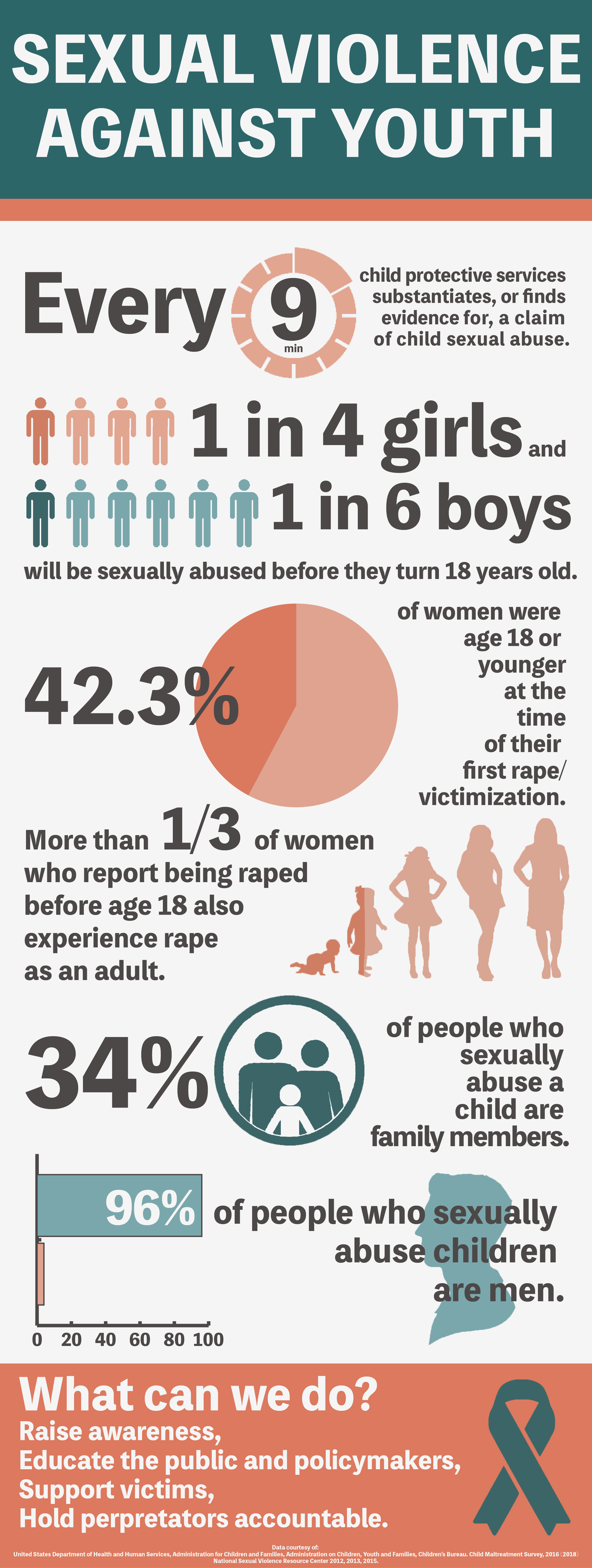
I chose to do my infographic on sexual violence against youth.

“Every 9 minutes, child protective services substantiates, or finds evidence for, a claim of child sexual abuse.”

I started out with the first data point in order to begin my narrative with a sense of urgency — a need to race against time. I visualized this through a clock icon that emphasized nine minutes. 

I then moved into presenting data points about the youth victims of sexual violence. This set up the issue that needs to be addressed.

“One in four girls and one in six boys will be sexually abused before they turn 18 years old.”

I thought that the second data point would be best visualized using people icons, so I darkened one of the people to stand for the “one” victim in the number of girls and boys who are sexually abused before the age of 18. 

“42.3% of women were age 18 or younger at the time of their first rape/victimization.”

For the third data point, I created a pie chart. At first, I had two pie charts — one that represented the fraction of female victims under the age of 10 and another that represented those between the ages of 11 and 17. However, Nick suggested that combining the two data points would create a more memorable statistic, and I agreed, so I did so. 

“More than ⅓ of women who report being raped before age 18 also experience rape as an adult.”

For the fourth data point, I found an image that represents a baby girl growing into an adult. The original image showed the continuation of growth through elderhood, but I chose to erase all by five of the figures because 1.) the data point only represents females under the age of 18 and 2.) five figures made it easier to represent a third. I did so by darkening roughly 1.6 of the female figures.

I then moved into presenting data points about the perpetrators of sexual violence against youth. I thought this would be a good way to lead up to the call to action at the very bottom of the infographic because these data points show who should be held accountable.

“34% of people who sexually abuse children are family members.”

I chose to represent the fifth data point using an icon of a family with a child. I feel that the circle shape of the icon contrasts the security and comfort that is supposed to come from family with the confinement that comes with being unable to speak up about sexual abuse especially when it is instigated by a family member. I also think that it serves to unify the infographic visually because every other data point utilizes circular shapes.

“96% of people who sexually abuse children are men.”

The final data point is visualized using a bar graph. I also took Nick’s advice for this one; a bar graph is one of the ways in which the huge disparity between female and male sexual abusers can be most dramatically represented. I thought there was too much blank space with just the bar graph and the text, so I kept the silhouette icon of a male’s profile that I had in one of my earlier drafts and placed it behind the text.

The last panel of the infographic contains some things we can do to stop, or at least better deal with, sexual violence against youth as well as the sources I gathered my data points from: the National Sexual Violence Resource Center and the U.S. Department of Health and Human Services. To the right, I included a teal color ribbon, which is the designated color for sexual assault awareness. This teal color was also the inspiration for the color theme of the infographic. I also wanted to be able to represent females and males without the use of the typical blue and pink, which I thought were a bit too bright for the topic, so I went for an orange color to complement the teal.

Think Before You Tweet

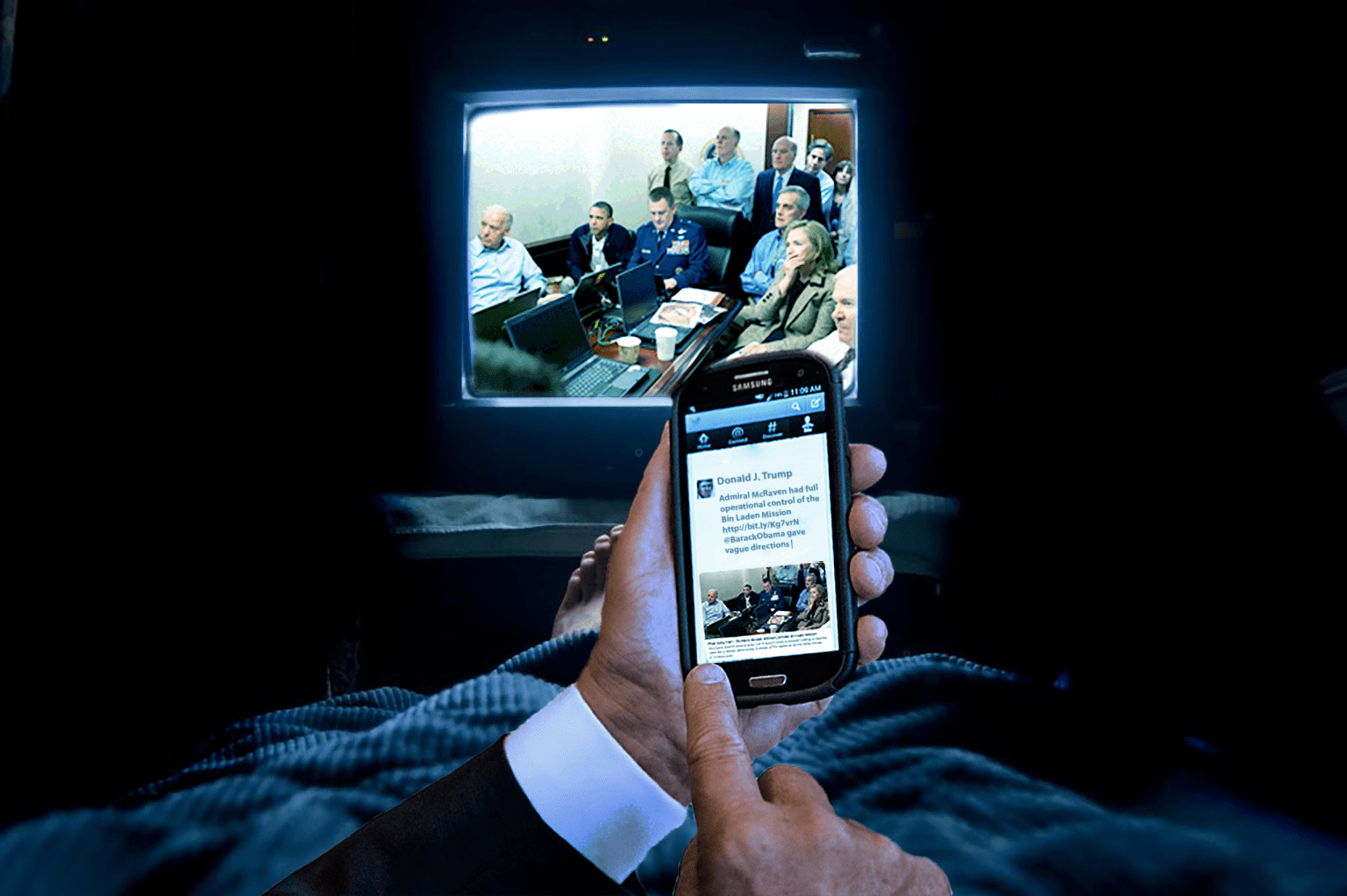
The original iconic image I chose (captured by Pete Souza, Official White House Photographer) was of Obama, Biden, and the national security team waiting on an update on the mission to kill or capture Osama Bin Laden. Through my manipulation of this image, I want to show the juxtaposition between the action taking place in the photo and Trump’s tendency to Tweet complaints without doing anything about it. 

“The Situation Room”
(Image courtesy of Pete Souza, Official White House Photographer)

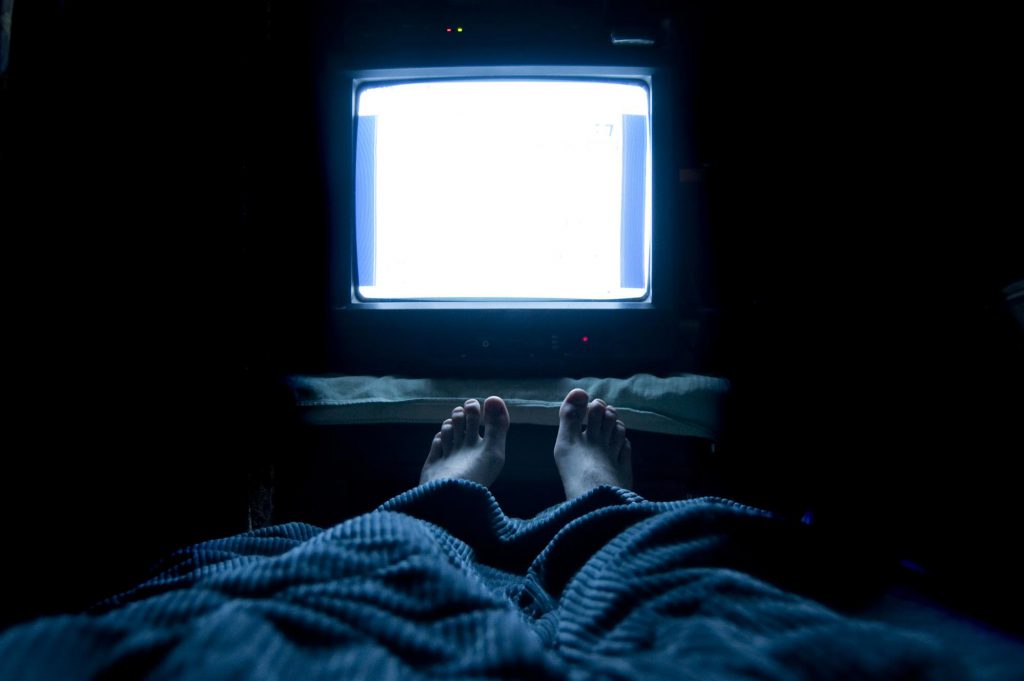
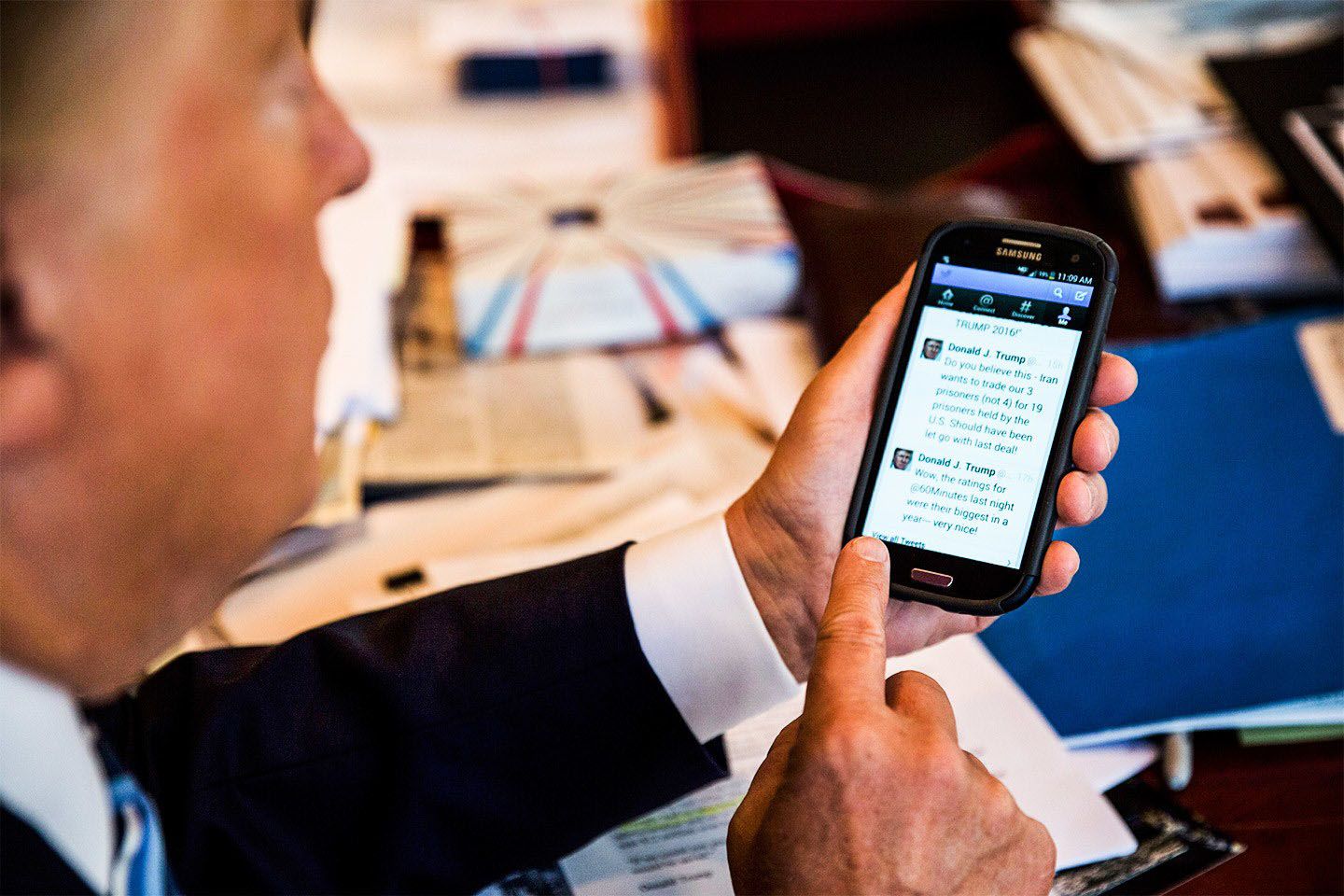
To do this, I pasted the iconic image onto a photo of a television in a dark room. I then cut out and pasted a photo of Trump’s own hands holding his smartphone to make it appear as if he was lounging comfortably while watching the mission take place on screen. Finally, I recreated Trump’s original Tweet, which was a critique of Obama’s approach to the mission, by erasing what was on his smartphone and replacing it with text and an image. I tried to incorporate the feedback I received in class, which was to make it clear that Trump was in the process of crafting the Tweet, by adding a text cursor at the end of the text. I also adjusted the coloring of all the elements to match the background and added blur and grain to the screens (TV and phone) to make them more realistic. 

Original element: person watching TV in a dark room
(Image courtesy of Replacement Remotes Blog)
Original element: Trump’s smartphone
(Image courtesy of Vanity Fair)
“Think Before You Tweet”: manipulated iconic image

Through showing both the action happening on the TV and Trump’s complacent Tweeting on his phone in the same frame, I hope to convey the immediacy of people’s online reactions (often negative) to political decisions — in this case, Trump’s reactions to anything Obama did during his presidency. By portraying Trump as under a blanket and taking part in leisurely activities, like using social media and watching TV, I want to emphasize the lack of thought and work that goes into a hate Tweet. I also want to show how politically polarized social media often is. The message that I hope to get across through this image manipulation is essentially: think before you Tweet.

Sources in the Spotlight: SMELL Test on a Times article

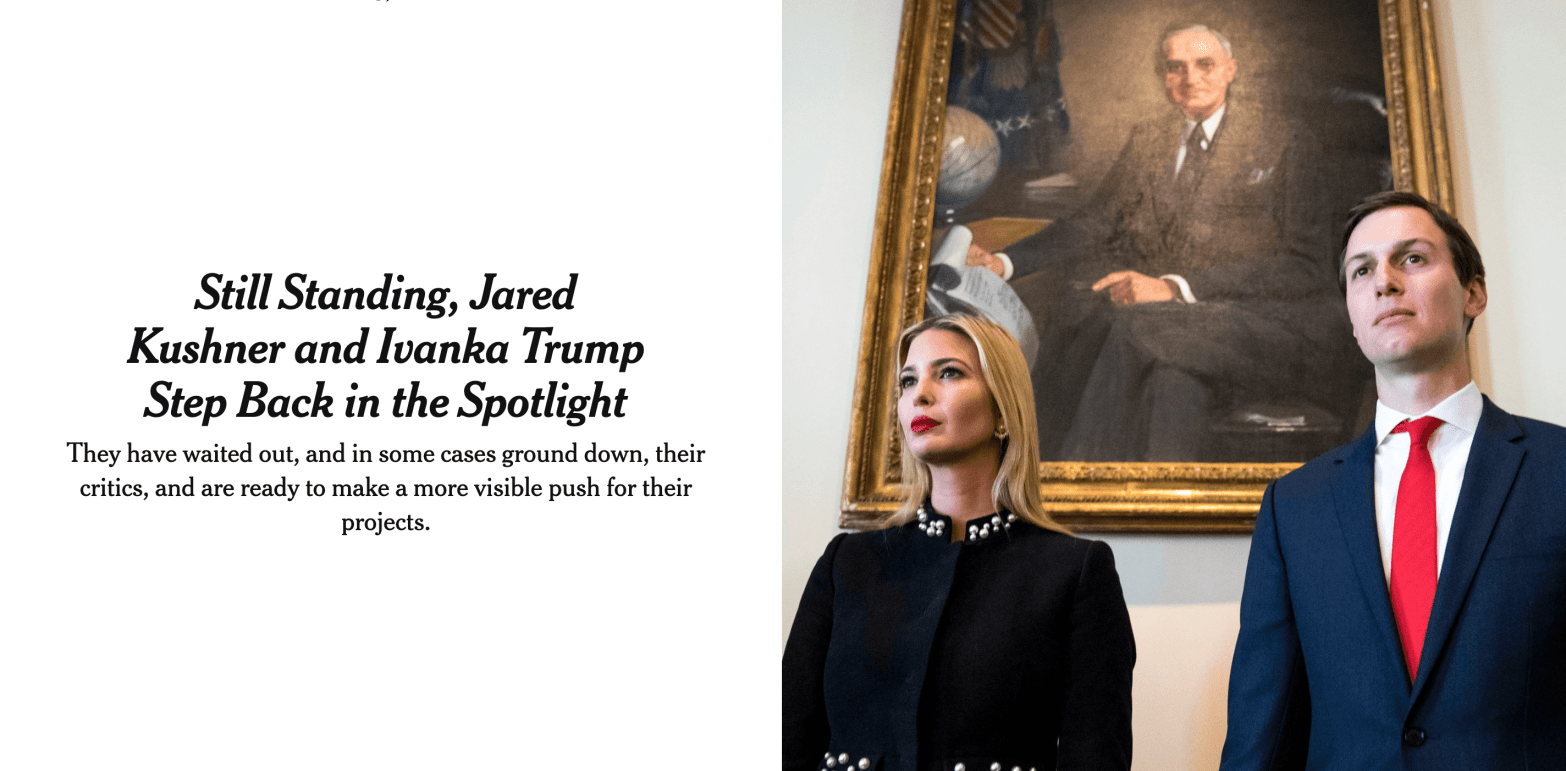
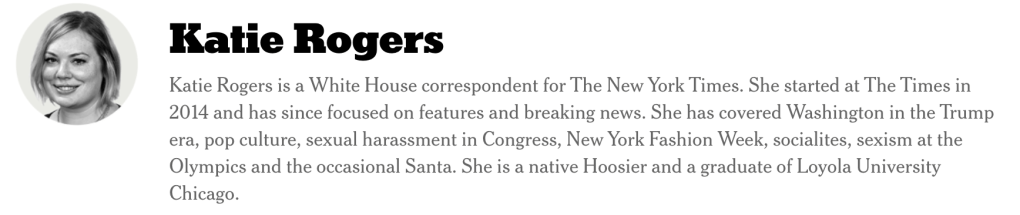
The New York Times leans left and has historically not been a supporter of Donald Trump or his family. “Still Standing, Jared Kushner and Ivanka Trump Step Back in the Spotlight” by Maggie Haberman and Katie Rogers is no exception. The article is written by two White House correspondents, one of which was part of a Pulitzer-winning team that reported on Trump’s connections to Russia (Haberman). While the article does not present an outright opinion on Kushner and Ms. Trump, it is “biased” in the sense that it serves to emphasize the tensions between the “Javanka” couple, Trump, and his aides so as to call into question the stability of Trump’s administration, which reveals the partiality the Times has against Trump. In addition, while this article appears to be factually accurate, it is not the best example of an effective use of sources. 

Reporters on story: “Still Standing, Jared Kushner and Ivanka Trump Step Back in the Spotlight.”
(Images courtesy of The New York Times)

The first source used is “five people who heard [Trump]” joke that he wishes he could have Tom Brady as a son-in-law instead of Kushner. While this is used as a humorous way to draw the reader into the article, I do not think it was an effective way to begin the article because it introduces ambiguity right from the get go. There is an attempt to add credibility to the source by adding the detail of a specific number, but other than that, we have no idea who these “people” are or where, when, and why they said this. 

As the article continues, the sources remain similarly vague. Haberman and Rogers cite “someone familiar with [Ms. Trump’s] thinking,” “the couple’s allies,” and “people close to [Ms. Trump].” The reporters are attempting to create a sense of close proximity because these sources are supposed to provide inside knowledge on Javanka, such as what Ms. Trump herself thinks about the end of her fashion brand. However, we still are unable to glean neither who these supporters are nor their motivations. Representing the opposing party are comparably vague sources including “[Mr. Kushner’s] detractors” and “critics.”

In this way, Haberman and Rogers attempt to make up for proximity lost because Javanka avoids speaking to reporters on record. It detracts from the strength of their article if quotes received directly from the subject in question are left out. As a compromise, the reporters accessed sources that would speak on the couple’s behalf. Steven Mnuchin, Treasury secretary, was “one of several allies the couple asked to speak on their behalf for this article.” He told the Times that the two are valuable partners of Trump’s cabinet. This information is blemished by the fact that the Times explicitly stated that Mnuchin was asked to speak on Javanka’s behalf because it shows the information he presents is not independent of the couple, and his motivation is likely to paint them in a favorable light.

Further into the article, it seems that Haberman and Rogers give up providing evidence to support Kushner’s strained relationship with Trump’s aides and instead opt to provide a long list of names of people who he has had disagreements with, starting with Trump’s campaign manager Corey Lewandowski and ending with his lawyer Marc Kasowitz. This is an attempt to strengthen the claim by virtue of the large number of people, but it fails to be very effective because of the lack of evidence attached to the names. In addition, it perhaps mistakenly assumes that all readers will have some knowledge of Kushner, otherwise there is no way to logically understand the connections between him and the people listed.

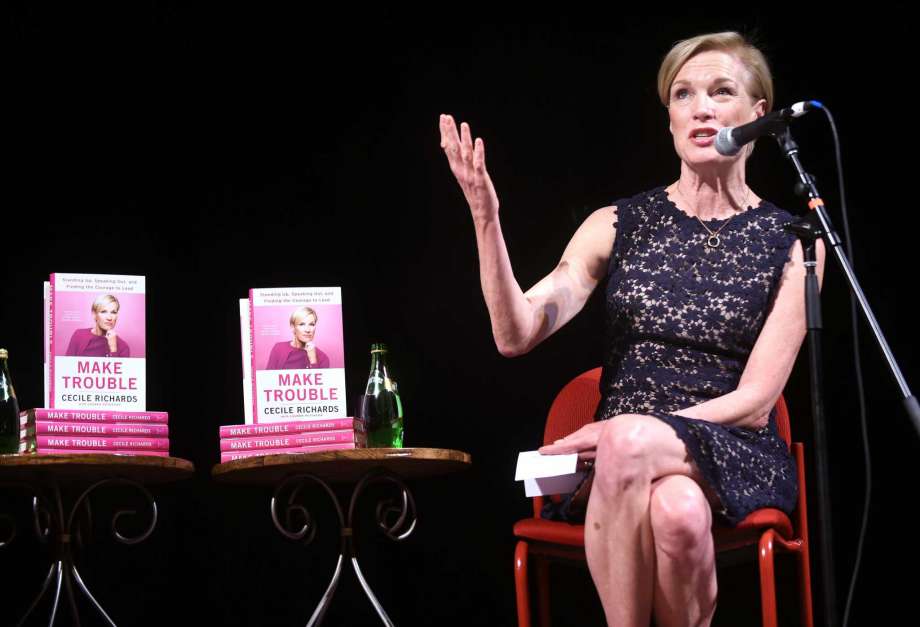
The article cites around four specific, named sources from both parties with evidence to support them. These include Democratic strategist and Trump administration critic Hilary Rosen, former Planned Parenthood president Cecile Richards, former White House press secretary Sara Huckabee Sanders, and Maine Republican Senator Susan Collins. While some of these sources are supposedly experts in politics (Rosen, Sanders, Collins), others still fall short of being effective sources for this article. Richards, for example, is cited through a memoir as saying that Javanka “had offered her a deal that felt like a ‘bribe’ — continued federal funding for the group in return for a halt to providing abortions.” Memoirs are a secondary source and rely greatly on the recollection of the author after the fact, making them not as reliable. In addition, Ms. Trump does make a valid point that Richards could have “initiated the meeting and later ‘mischaracterized’ the discussion ‘for political and personal profit’” off her book.

Cecile Richard with her memoir: Make Trouble.
(Image courtesy of the New Haven Register)

Based on my findings, the use of anonymous/vague sources damages the credibility of the article. Despite reporting “facts,” it is clear from the way the content is laid out that the authors are disapproving of Trump’s policies and Javanka’s unwillingness to speak to the press. As a result, this article will read easier if you are politically and socially left leaning. However, because the Times is relatively transparent with their partisan leaning, having endorsed the democratic candidate for president an overwhelming number of times, for example, there is nothing inherently wrong with how Haberman and Rogers constructing their article in the way that they did. Despite this, I believe the reporters could have done better with their sources for this article.

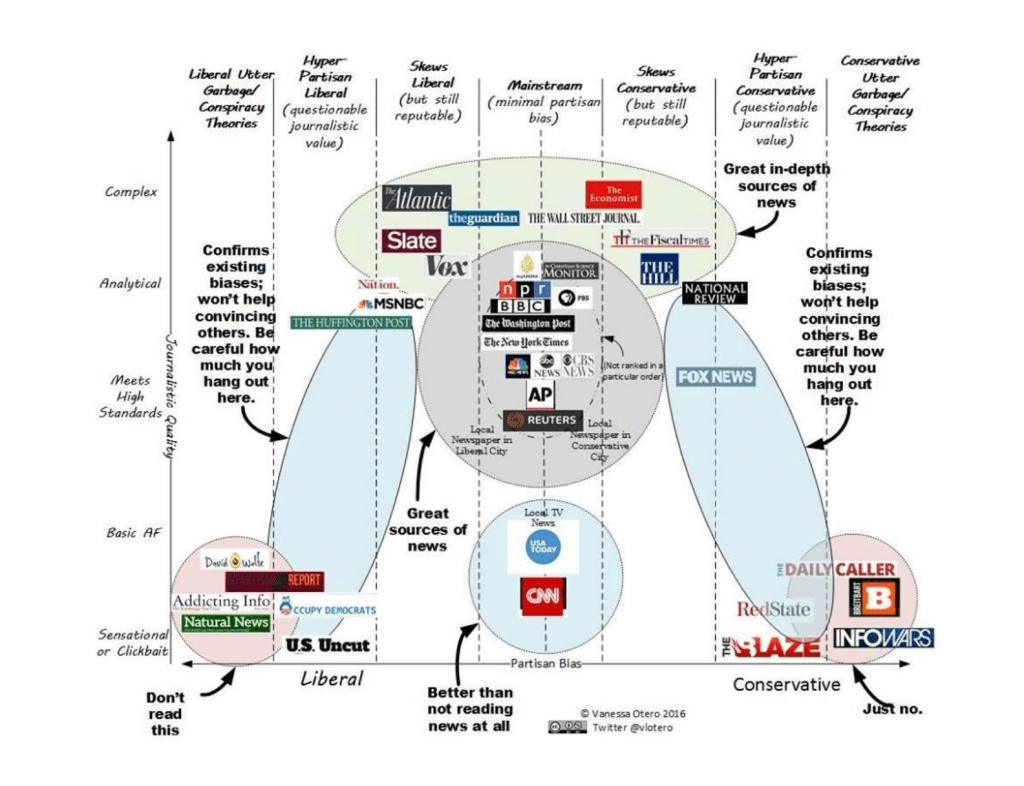
Media bias chart showing the essentially inherent bias of all sources of media.
(Image courtesy of Ad Fontes Media)

(Featured image courtesy of The New York Times)

How my use of media made me👤😐 not 🗣👥😊

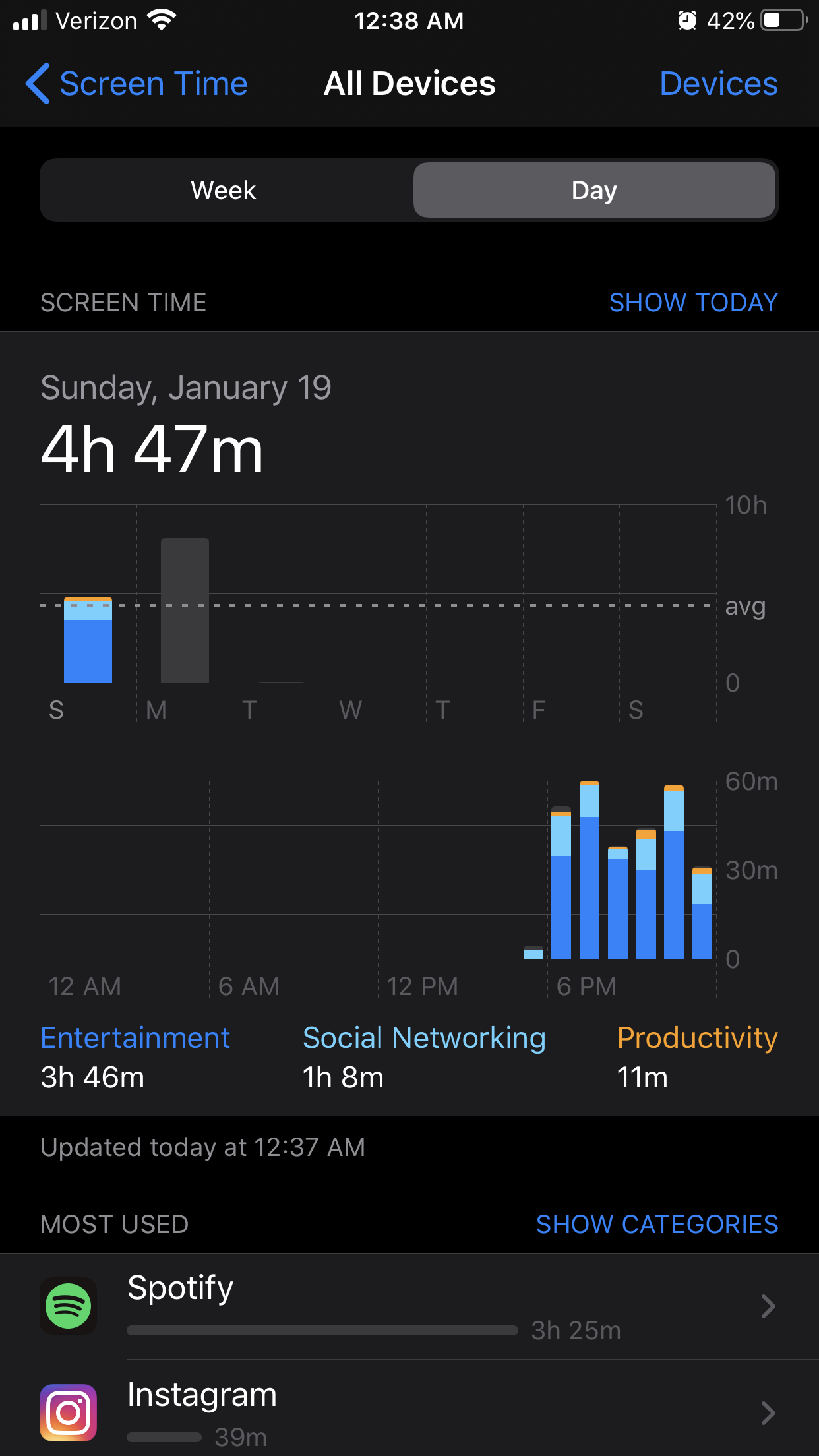
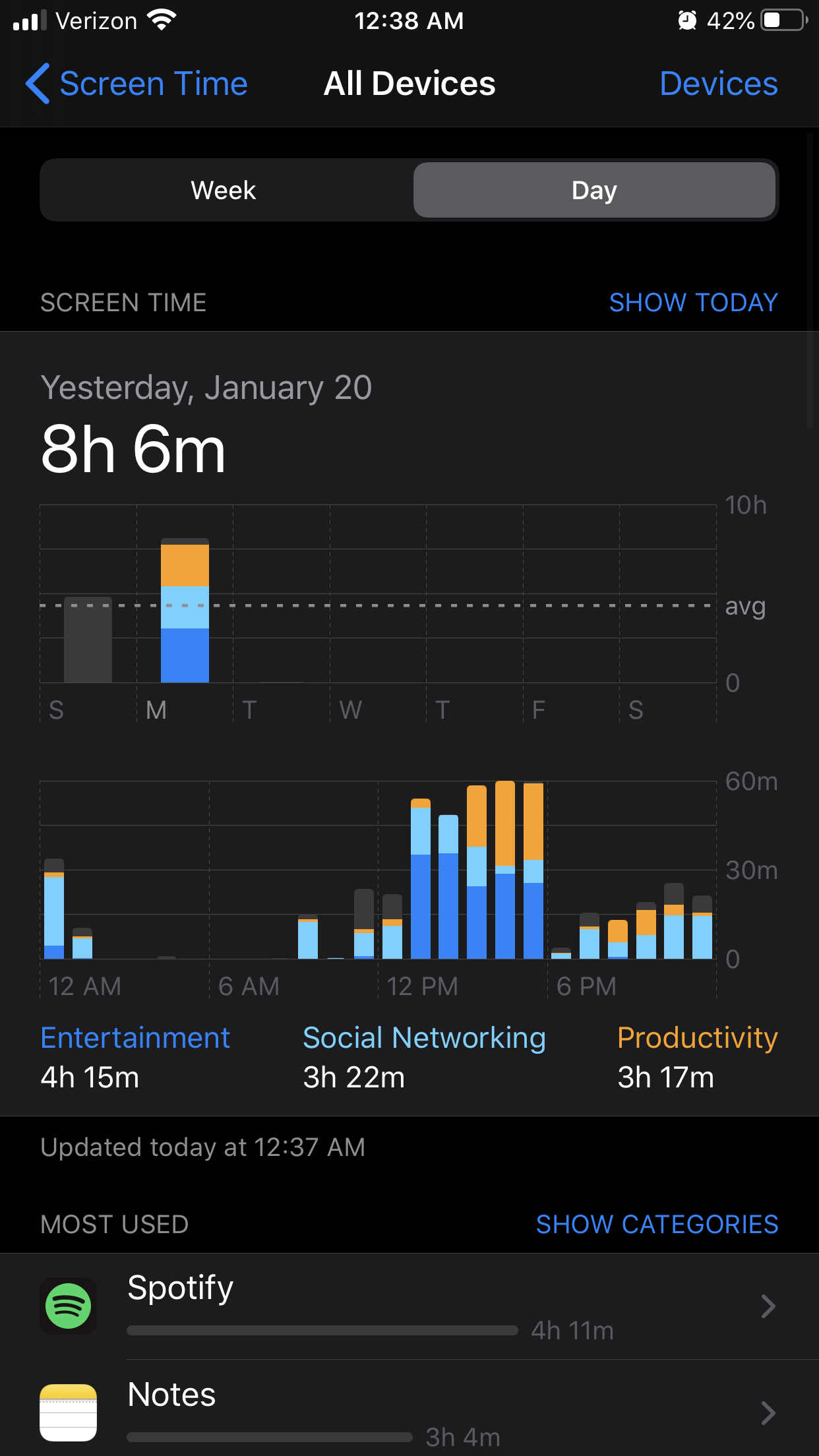
Over 24 hours, I spent 12 hours and 15 min not on my devices, ten of which I was asleep for. This means I spent almost 85% of my waking hours interacting with some form of media, largely social media. As a result, I know where my friends dined on Saturday (courtesy of SNS stories), but I am less informed on world or even local events Over 24 hours, I spent 12 hours and 15 min not on my devices, which means I spent almost 85% of my waking hours interacting with some form of media, largely social media. As a result, I know where my friends dined on Saturday (courtesy of SNS stories), but I am less informed on world or even local events that occurred during that time (courtesy of news outlets, or lack thereof). My use of media detracted from productivity, and while it gave me a false sense of connectedness, it prevented me from having face-to-face interactions.

I default to SNS when I am bored or feel I have nothing to do. There is an ease and mindleI default to SNS when I feel I have nothing to do. There is an ease and mindlessness to scrolling through my Instagram feed that I do not experience when reading a New York Times article, for example. The information presented on social media is easily digestible; you can open an app, interact with a post, and close the app in a matter of seconds. News articles take time to read and process, however, considering the hours I spend on my phone after falling down the social media rabbit hole, I might as well devote this time to appreciating longform journalism instead. 

My social media use may be an unconscious effort to stay connected, as particularly on this day, I spent a lot of time alone in my room. However, this was unsuccessful, as evidenced by the fact that my mood during the time I spent on social media was mostly “neutral.” I was only “happy,” when I was texting friends I wanted to talk to. That being said, texting is much less nuanced and hardly a replacement for in-person interaction, not that it was a surprise that I found sending my friends blurry photos of half my face on Snapchat to be less valuable than actual conversation.

Even when I was not actively engaging with media, I had Spotify playing in the background. When studying, I like to put on music in a language I do not understand. Ultimately, the mental stimulation is inherently somewhat of a distraction anyway, however, the bigger distraction was the ability to access media across multiple devices. While Facetiming my family on my laptop, I was able to simultaneously check SNS on my phone. It was also tempting to check my phone while I was supposed to be watching a less than fascinating film for school on my laptop. Again, this took away from my ability to have a real conversation and learn new things.

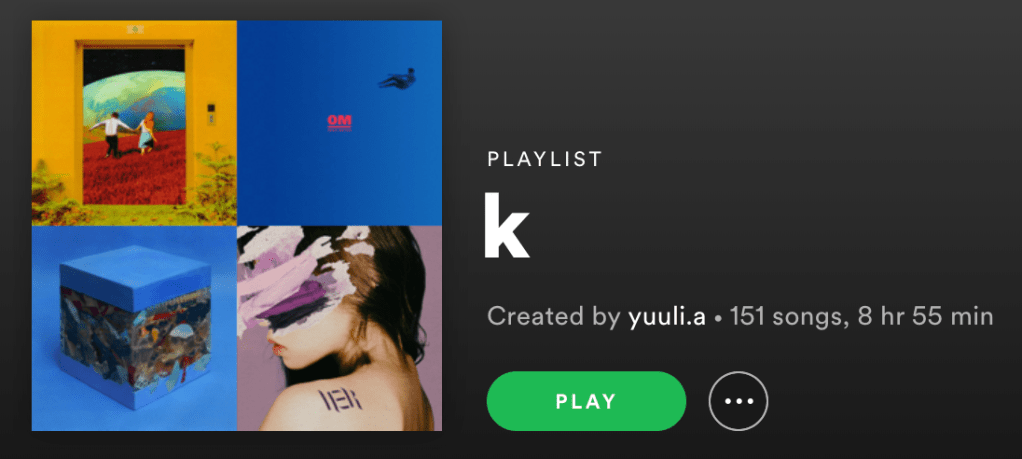
My playlist of Korean songs that I often listen to while studying.

I also use media as a kind of defense mechanism. When eating dinner alone in the I also use media as a kind of defense mechanism. When eating dinner alone in the dining hall, I watched Good Morning Call on Netflix to be entertained, but also to avoid being awkward. Eating alone is not wrong, but I feel my generation has developed an aversion to being alone in a crowded setting without doing something. My phone provided me with the facade that I was occupied, which detracted from my ability to actually be occupied by interacting with others in-person.

The movie that I needed to watch.
(Image courtesy of Fandango)
The show that I ended up watching.
(Image courtesy of MyDramaList)

Link to media consumption log

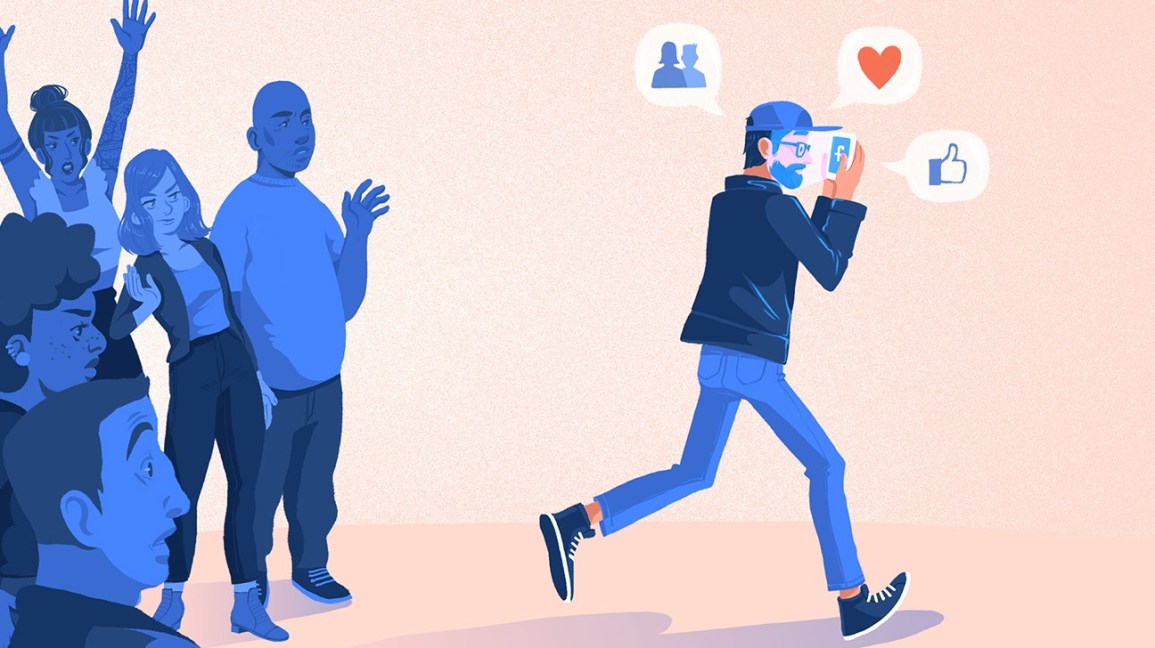
(Featured image courtesy of Healthline)

Design a site like this with WordPress.com
Get started